On July 12, 2026, USPS cut its dimensional weight divisor from 166 to 139 and started rounding every fractional inch up. That closed the last big gap between USPS, UPS, and FedEx. For years, sellers with light, bulky products could move volume to USPS and dodge the worst dimensional weight (DIM) charges. That option is now mostly gone. Going into Q4, every carrier bills an oversized box the same way: on its volume, not its weight.
How dimensional weight is calculated
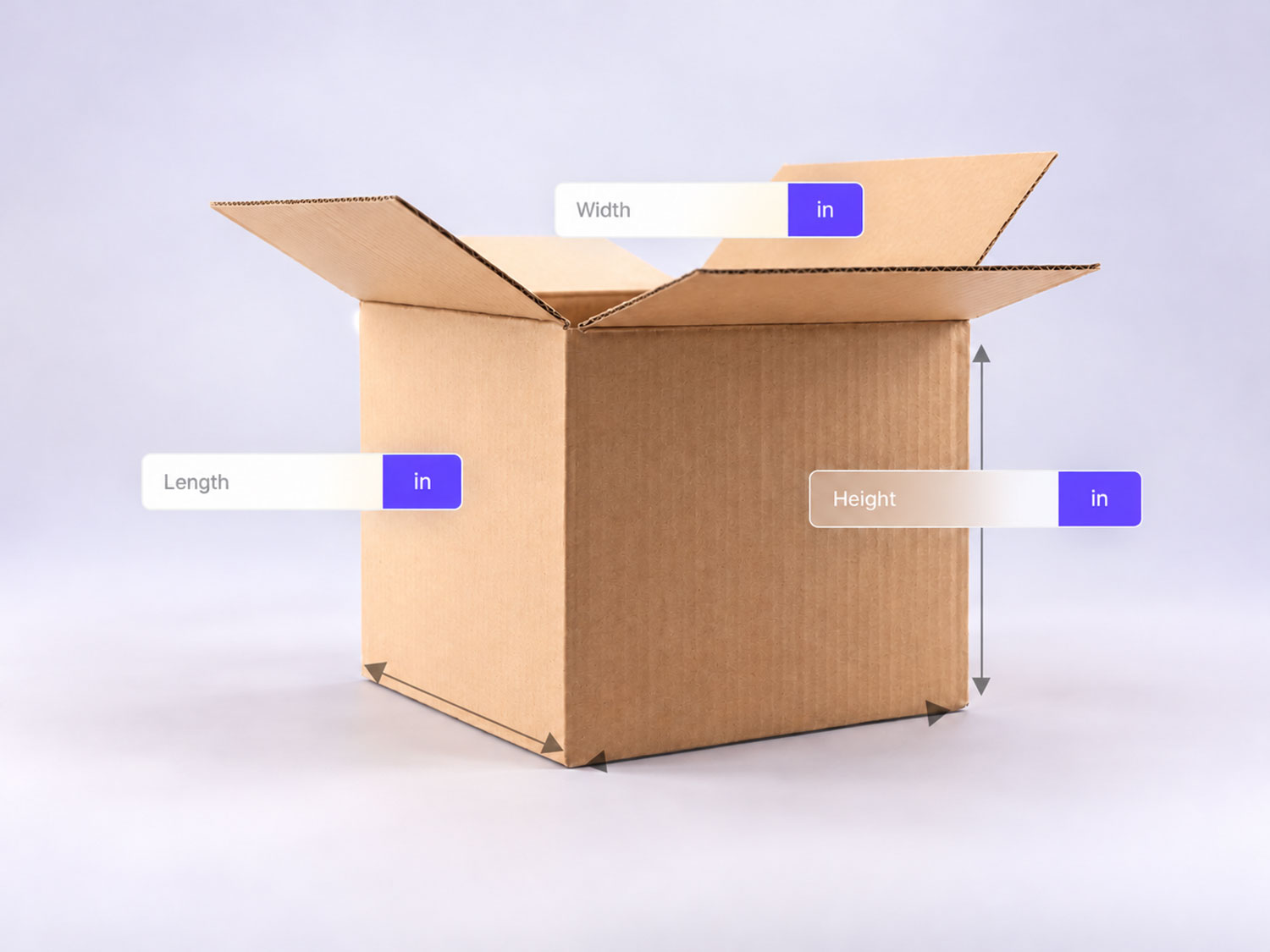
DIM weight is length × width × height in inches, divided by the carrier's divisor, then rounded up to the next pound. The carrier charges the higher of DIM weight and actual weight. So a 16 × 14 × 10 box holding a 4 lb product has a volume of 2,240 cubic inches. At USPS's old divisor of 166, it billed at 14 lb. At 139, it bills at 17 lb, more than four times its real weight. UPS and FedEx have applied 139 to most domestic daily rates for years. As of August 2025, both also round fractional dimensions up to the next whole inch.
139
USPS DIM divisor since July 12, 2026
~19%
Rise in billable weight over one cubic foot
5–7%
Annual savings DHL measured on carton sizing
$11.90
UPS Additional Handling peak surcharge
The USPS details come from its Postal Regulatory Commission filing (Docket CP2026-8), as summarized by SupplyChain247 and Ship.com. The change covers Priority Mail Express, Priority Mail, Ground Advantage, and Parcel Select. The DHL figure comes from carton set research published in the Journal of Business Logistics and reported by Supply Chain Dive. The UPS peak surcharge schedule is from UPS's August 2026 demand surcharge update, as tracked by Reveel, and runs from November 22 to December 26, 2026.
DIM rules by carrier in 2026
| Carrier | How DIM Is Applied | |
|---|---|---|
| 🟫 | UPS | Divisor 139 on daily rates, DIM on every package, fractional inches rounded up, large package over 48" or a 30" side |
| 🟪 | FedEx | Divisor 139 on most services, DIM on every package, fractional inches rounded up, large package over 48" or a 30" side |
| 🔵 | USPS | Divisor 139 since July 12, DIM only over 1,728 cubic inches, fractional inches rounded up, nonstandard fee over 22" |
USPS still has one rule the others don't: packages of one cubic foot (1,728 cubic inches) or less are billed on actual weight. That threshold is now the most valuable line in parcel shipping, and the new rounding makes it easy to cross by accident. A 12 × 12 × 12 box is exactly 1,728 cubic inches, so it bills on actual weight. If one side measures 12⅛ inches, it's recorded as 13. The volume becomes 1,872 cubic inches, and the box bills at 14 lb no matter what's inside it. Measure your cartons as built, with the bulge from tape and overfill, not as the box maker's spec sheet says.
Where DIM charges hide in your shipping bill
Most DIM overspend comes from three habits. The first is the "standard box" problem: a warehouse stocks four or five box sizes and fits every order into the closest one that works, so a 2 lb order ships in a box built for 6 lb. The second is fractional sizing. A 12.25 × 9.5 × 6.25 box is now billed as 13 × 10 × 7, which is 7 lb DIM instead of the 5 lb a true 12 × 9 × 6 box would bill. The third is using boxes when a mailer would do. Soft goods, apparel, and non-fragile items in a poly or padded mailer usually bill on actual weight, because the volume never gets high enough for DIM to win.
Carriers don't charge for what you ship. They charge for how much space it takes up on the truck, and the box size is your choice.
Amazon applies the same logic on its end. FBA fulfillment fees for most size tiers above small standard use the greater of unit weight or dimensional weight (L × W × H ÷ 139). A polybag that adds an inch to each side can push a product into a higher weight band permanently. That cost hits every unit sold, not just one shipment. Since Amazon ended its US prep services on January 1, 2026, how a unit is bagged and boxed before it goes to FBA is decided by the seller or their prep partner. That makes it a fee decision, not just a packaging decision.
How to cut DIM costs this quarter
Start with data, not new boxes. Pull 90 days of carrier invoices and flag every package where billed weight is higher than actual weight. In most catalogs, a small group of SKUs and box sizes account for most of the gap. Fix those first: add one or two box sizes that fit your top sellers closely, move non-fragile items into mailers, and remove inserts or void fill that add height. Then lock it in. Set a box size for each SKU and each common multi-unit order in the warehouse system, so packers aren't choosing by eye at 4 p.m. on a peak day.
Questions to ask your fulfillment partner
Do you measure every outbound package
Ask whether cartons are measured by a dimensioner or entered by hand from a box spec. Carriers audit with scanners, so a 3PL that bills you from the spec sheet will be wrong in the carrier's favor.
How many box sizes do you stock
Four or five generic sizes almost guarantees wasted space. Ask whether they can add custom sizes for your top SKUs and whether there's a cost for storing them.
Is box selection automatic per SKU
The warehouse system should assign the box based on item dimensions and order contents. If packers choose, ask how they audit that choice.
Which of my orders bill on DIM weight
A good partner can send a report of billed weight vs. actual weight by SKU and box. If they can't, they aren't tracking the biggest variable cost on your invoice.
Do you rate-shop with DIM included
Comparing carriers on base rates alone means little now that all three use 139. Ask whether the label system compares the final billed price, including DIM, surcharges, and USPS's one-cubic-foot rule.
How do you pack FBA units against size tiers
Ask whether they check the finished prepped unit's dimensions against Amazon's size tier limits before sending inventory in.
Dimensional weight isn't a carrier quirk you have to accept. It's a charge you control through packaging. With USPS now on 139 and peak surcharges running through mid-January 2027, an extra inch on your most common box costs more than it ever has. Fixing it costs a few new box sizes and better packing rules.
Are Oversized Boxes Quietly Inflating Every Shipping Label You Pay For?
OneDayBundle measures every package, matches each SKU to the right box size, and rate-shops UPS, FedEx, and USPS on the final billed price.
Get a Packaging Audit