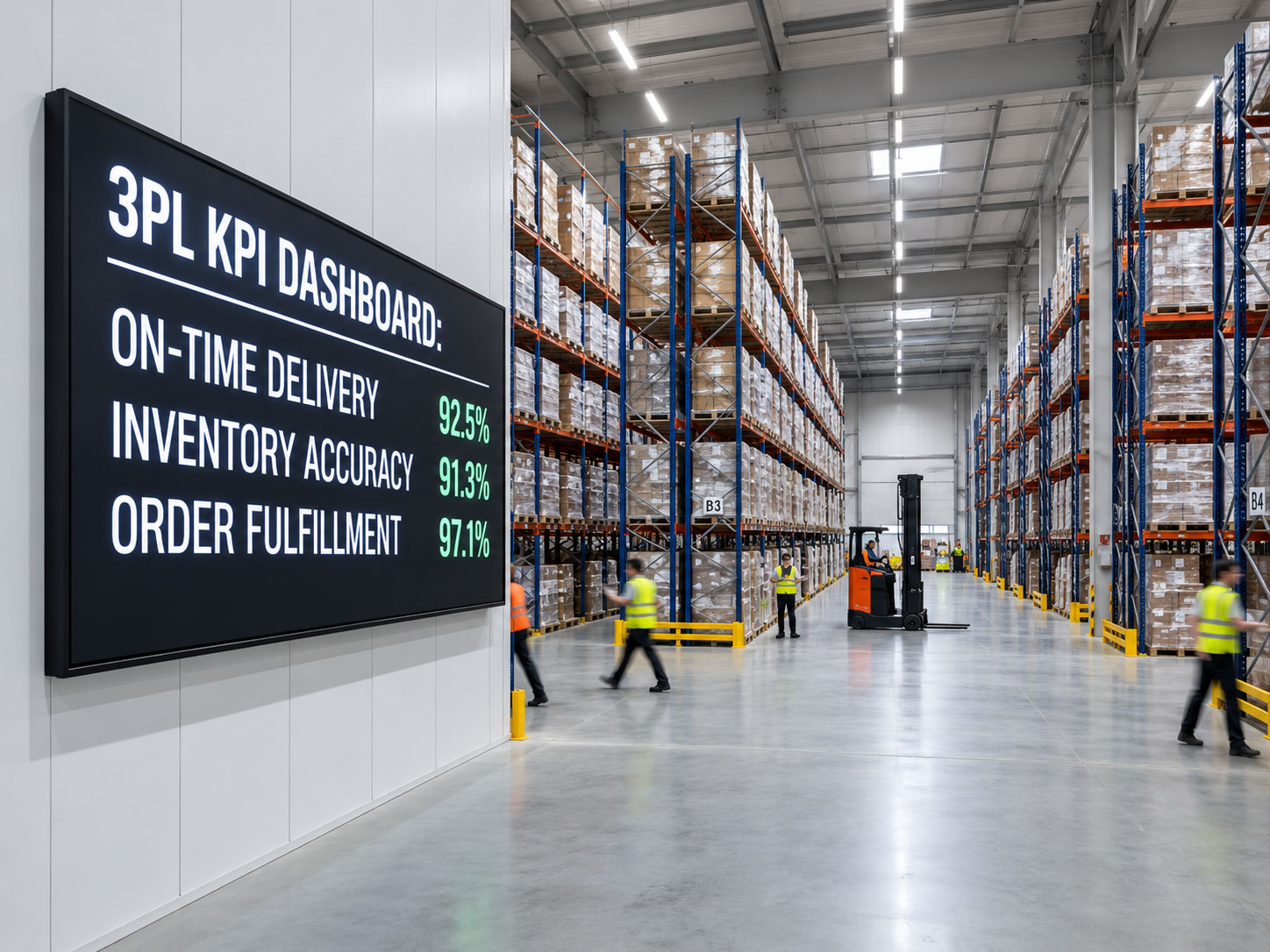
Most sellers sign a 3PL contract, look at the price per pick, and move on. The number that actually determines whether the relationship works — order accuracy, on-time ship rate, dock-to-stock time — rarely gets written down as a hard commitment. That gap is where margin quietly leaks out: a 2% error rate looks small until you multiply it across a full order volume and add up the refunds, reshipments, and support tickets it generates.
What an SLA Should Actually Cover
A real fulfillment SLA is a short list of numbers with consequences attached, not a paragraph of marketing language. At minimum it should name a target and a floor for order accuracy, on-time ship rate, inventory accuracy, and receiving turnaround (dock-to-stock time) — plus what happens when the 3PL misses them. If your contract doesn't name these four, you don't have an SLA, you have a sales pitch.
99.5–99.9%
Best-in-class order accuracy for top 3PLs (WERC benchmarks)
0.5–2%
Typical error rate without barcode verification at pick
$50–$100
All-in cost of a single mispick: returns, reshipping, support
95%
Perfect order rate among industry median performers
On-Time Shipping Is a Moving Target by Volume
On-time ship rate expectations scale with order volume, and a 3PL quoting one flat number for every seller is glossing over that. A startup shipping under 100 orders a day and an enterprise brand shipping 10,000+ should not be held to the same bar — and shouldn't be charged the same rate for hitting it, either. Ask your 3PL which tier your volume falls into and what rate they commit to at that tier, not what their best month ever looked like.
| Volume Tier | Orders/Day | Target On-Time Rate | |
|---|---|---|---|
| 🌱 | Startup | Under 100 | 95% |
| 📈 | Growth | 100–1,000 | 97% |
| 🚀 | Scale | 1,000–10,000 | 98.5% |
| 🏢 | Enterprise | 10,000+ | 99.5% |
Marketplace channels add their own floor on top of whatever your 3PL commits to. Amazon requires on-time shipment rates above 99% and caps late shipments at 4%; Walmart requires on-time delivery above 90% and valid tracking above 99%. If your 3PL's internal SLA is below what your sales channels require, you're carrying that gap as risk, not them.
Why Order Accuracy Moves the P&L, Not Just the Reviews
A wrong-item shipment doesn't cost you a refund — it costs you a refund, a reshipment, a return-freight label, a support ticket, and often a bad review that suppresses future conversion. Distribution centers running weak pick verification lose an average of close to $585,000 a year to mis-picks at scale, and a single mispick can cut 13% off that order's margin once every downstream cost is counted. At 1,500 orders a day, even a 1–2% error rate compounds into six figures annually — money that never shows up as a line item because it's scattered across customer service hours, chargebacks, and lost repeat purchases.
An accuracy rate of 97% sounds fine until you realize it means three out of every hundred customers get the wrong order — and every one of those becomes a support ticket, not just a shipping cost.
Questions to Ask Your Fulfillment Partner
What's your trailing 90-day order accuracy rate, not your target?
Ask for the actual measured number from their WMS reporting, not the number in their sales deck. A 3PL that can't produce this on request usually isn't tracking it closely.
What's your dock-to-stock time for inbound receiving?
This is how long inventory sits unsellable after it arrives. Anything over 24–48 hours during non-peak season should be explained, not shrugged off.
What credit or remedy applies when you miss the SLA?
A number with no consequence attached is a suggestion, not a commitment. Get the remedy — credit, fee waiver, escalation path — in writing.
How do you verify picks — barcode scan, weight check, or manual?
Barcode-verified picking is the single biggest lever on accuracy; manual-only picking almost always runs error rates several times higher.
Can I see your SLA performance report, and how often?
Monthly reporting cadence, delivered proactively rather than on request, is a strong signal of an operation that manages to its own numbers.
What happens to my inventory accuracy during peak season?
Accuracy rates that hold in July and slip in November tell you where the operational stress actually shows up.
None of this requires enterprise-level negotiating leverage. Even a seller shipping a few hundred orders a day can ask for these four numbers in writing before signing, and can ask for a monthly report afterward. The 3PLs worth working with will already have the answers ready — the ones that hesitate are telling you something about how closely they track their own performance.
Want a Fulfillment Partner Whose SLA Numbers Hold Up Under a Spreadsheet, Not Just a Sales Call?
OneDayBundle publishes order accuracy, on-time ship rate, and dock-to-stock benchmarks to every client and puts the remedy in writing before you sign.
Talk to Our Team