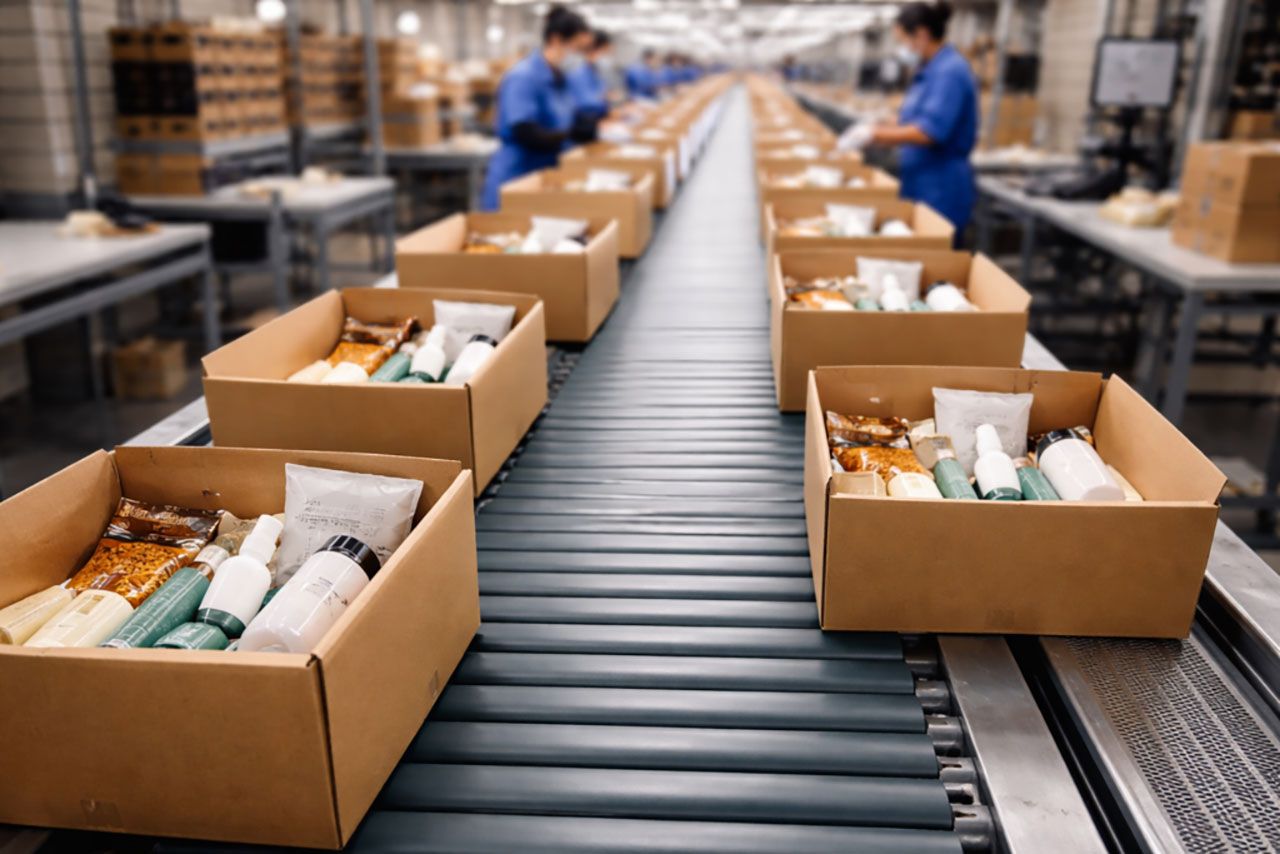
Subscription box fulfillment is the monthly or quarterly process of receiving every component, assembling identical or personalized boxes, and shipping the whole subscriber base inside a fixed window — usually 3 to 7 days. It looks like regular e-commerce fulfillment, but it runs differently. Regular orders arrive in a steady stream. A subscription cycle arrives all at once, and if one component is late, every box is late.
That is why subscription brands outgrow garage packing and general-purpose warehouses faster than almost any other DTC model. Below is how a subscription cycle actually works at a warehouse, what it costs, where cycles fail, and what to ask a 3PL before you hand over your next box.
~40%
Subscribers who canceled at least one subscription
1/3+
Cancel within the first three months
13%
Cancellations tied to slow or late delivery
10–15%
Typical monthly churn for curation boxes
Read those numbers together: you pay to acquire a subscriber, then you have roughly three boxes to prove the value. A late box in month one or a crushed box in month two is not a shipping problem — it is a lifetime value problem. Sources: McKinsey — Thinking inside the subscription box and the Pitney Bowes subscription survey.
How a subscription fulfillment cycle works
A typical monthly cycle has five stages. First, inbound: every component for the cycle — products, inserts, tissue, branded mailers — must be received, counted and put away before a hard cutoff, usually 5 to 10 business days before ship start. Second, the order drop: your subscription platform (Recharge, Cratejoy, Subbly, Shopify Subscriptions) generates the renewal orders after billing runs, and the 3PL imports them as one batch.
Third, kit build: the warehouse either pre-assembles boxes on a dedicated line before orders arrive, or picks each box against its order if contents vary by subscriber. Fourth, labeling and carrier handoff: thousands of labels are bought in one batch, and carriers need advance notice so they send enough trailers. Fifth, exceptions: failed payments, address changes, skipped months and out-of-stock substitutions — these are the 2–5% of boxes that eat most of the labor.
Pre-built kits vs pick-to-order boxes
The single biggest decision in subscription fulfillment is whether the box is identical for everyone or varies by subscriber. Identical boxes can be assembled on a line before billing even runs, which compresses the shipping window to 1–3 days. Variable boxes — size variants, flavor preferences, add-ons, "build your own" — must be picked against each order, which needs a WMS that handles kits with variants and a team that can verify each box by scan.
| Box Model | How the Cycle Runs | |
|---|---|---|
| 🎁 | Pre-built identical box | Assembled before the order drop on an assembly line, ships in 1–3 days, error risk low and batch-level, priced as a flat per-box fee — best for curation and mystery boxes |
| 🧩 | Variable / personalized box | Assembled after the order drop by pick, verify and pack, ships in 3–7 days, error risk higher and per-box, priced per box plus per piece — best for replenishment and preference-based boxes |
Most growing brands end up in a hybrid: a core box built on a line, plus add-ons and variants picked on top. Make sure your 3PL can run both in the same cycle without splitting your shipment into two waves.
What subscription box fulfillment costs
Subscription box fulfillment is usually priced in one of two ways. A flat per-box fee — commonly quoted in the $3–$8 range — covers assembly and packing for a fixed number of items. Per-piece pricing adds roughly $0.15–$0.50 per item on top of a base order fee and fits boxes where item count changes by subscriber. Add storage, receiving, packaging materials and postage, and all-in landed cost for a standard 2–5 lb box typically lands in the low-to-mid teens per box.
Postage is the biggest line, and it is driven by box size more than weight. A box that is one inch too large can jump into a higher dimensional-weight tier on every single shipment — multiplied by your full subscriber count, every cycle. Size the mailer to the contents before you print 10,000 of them.
In subscription fulfillment, the warehouse does not fail on cycle day. It fails ten days earlier, when one component misses the inbound cutoff and nobody flags it.
Hidden costs usually come from three places: rework when a component arrives in the wrong count or packaging, re-ships for damaged or wrong-variant boxes, and storage for leftover components after a cycle closes. Ask for these in writing — they vary far more between providers than the headline per-box fee.
Where subscription cycles break
Late components are the number one failure point. A supplier ships the hero product three days late, and the brand has to choose between holding every box or shipping without it. A good 3PL tracks inbound against the cycle bill of materials and warns you as soon as an ASN is late, not when the trailer fails to show up. The second failure point is billing-to-warehouse sync: subscribers who skipped, canceled or changed address after the order export still get a box.
The third is damage. Subscription boxes are often printed, unboxing-focused mailers with no outer carton, which makes them vulnerable in parcel networks. Run a drop test on a new mailer design before committing to a full cycle, and track damage claims by cycle so you can see if a packaging change helped.
Cancellation rules affect fulfillment too
The FTC's federal "click-to-cancel" rule was vacated by the Eighth Circuit in July 2025, and the FTC reopened rulemaking in March 2026 — so no nationwide rule is in force today. But state laws are: California has required online cancellation and a click-to-cancel option next to retention offers since July 1, 2025, and New York's amended auto-renewal law took effect in November 2025. When cancellations get easier, your order export has to be timed tighter, or you will ship boxes to people who canceled yesterday. See Jones Day's 2026 update on the FTC rule.
Questions to ask a subscription fulfillment partner
What is your inbound cutoff per cycle
How many business days before ship start must all components be received, and what happens if one SKU is short or late?
How fast can you ship a full cycle
Ask for the actual ship window at your current subscriber count and at 3x — and whether pre-built and variable boxes ship in the same wave.
Which subscription platforms do you integrate with
Confirm a native connection to Recharge, Shopify Subscriptions, Cratejoy or your platform, and how late you can re-sync skips and cancellations.
How do you verify box contents
Scan-verified packing per box catches wrong variants; visual checks at a line do not. Ask for the cycle-level accuracy rate.
How do you handle leftover components
Find out whether leftovers are stored, rolled into the next cycle or sold through your store, and what storage costs after cycle close.
Can you also ship one-off and Amazon orders
Most subscription brands add a shop, gift boxes or Amazon listings — one partner and one inventory pool saves you a second migration later.
The right partner treats your cycle as a project with a timeline, not a pile of orders. If a 3PL cannot tell you the inbound cutoff, the ship window and the exception process in the first call, it has not run subscription cycles at scale.
Need a Fulfillment Partner That Ships Your Whole Subscription Cycle On Time?
OneDayBundle receives your components, builds every box and ships the cycle from our Florida warehouse — with subscription, DTC and Amazon orders in one inventory pool.
Get a Fulfillment Quote